
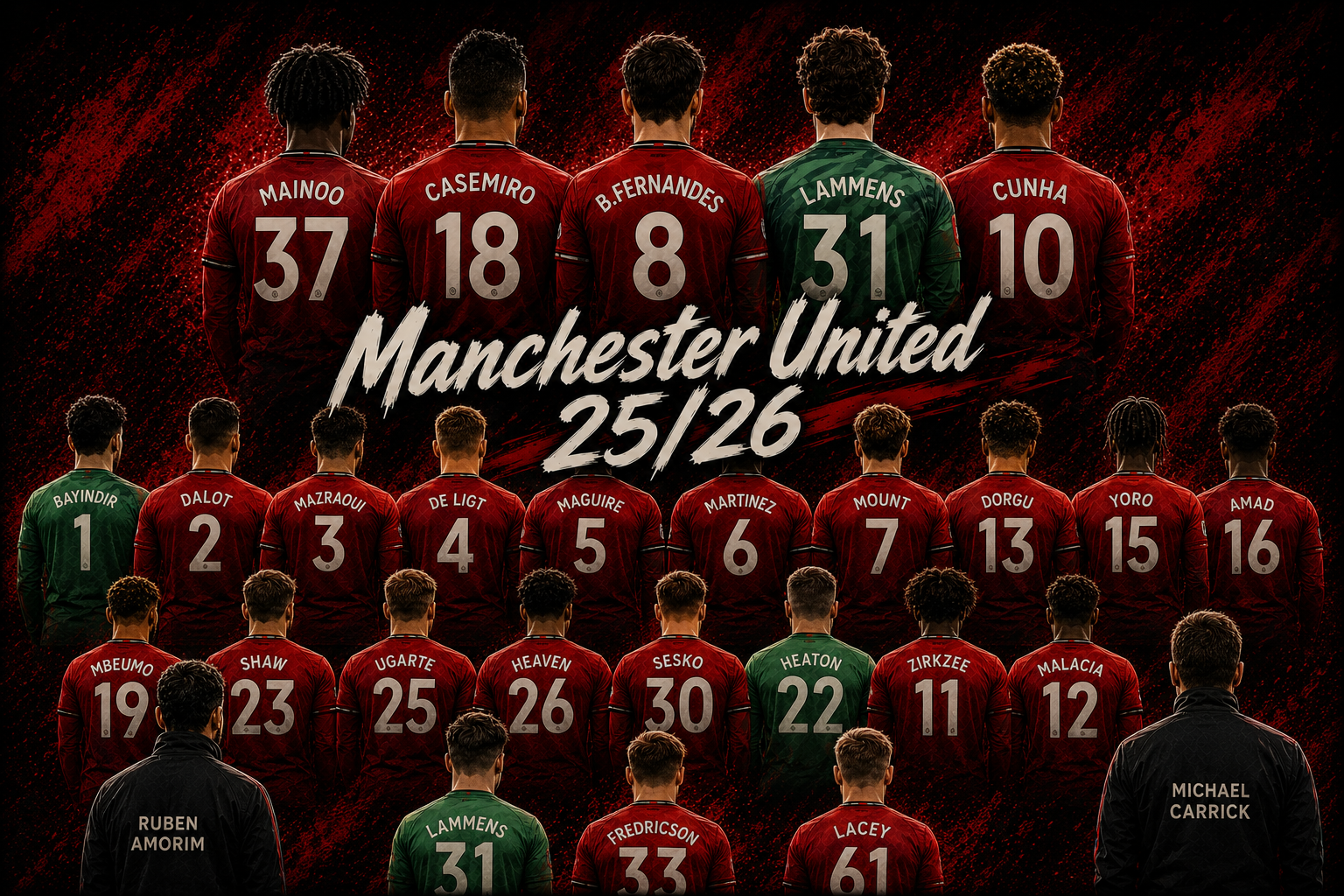
Contents :
1. Moments of the Season
2. Competition Results
3. Toughest Opponents
4. Transfer Window Verdict
5. Final Grade
[ moments of the season ]


[ Competition results ]


| 24/25 | 25/26 |
| 15th | 3th |
| 11 Win / 9 Draw / 18 Loss | 20 Win / 11 Draw / 7 Loss Amorim: 8W 7D 5L Fletcher: 1D Carrick: 12W 3D 2L |
| GF44 GA54 GD-10 | GF69 GA50 GD+19 |


| 24/25 | 25/26 |
| Round 5 | Round 3 |


| 24/25 | 25/26 |
| Quarter-Final | Round 2 |
A 15th-place league finish and a Europa League runners-up spot the previous season had left United without Champions League football — meaning the 25/26 campaign was contested across just three competitions: the Premier League, the FA Cup, and the Carabao Cup.
In the league, the season was shared across three managers: Ruben Amorim took charge of the opening 20 matches, Darren Fletcher oversaw one, and Michael Carrick managed the remaining 17. The end result was a third-place finish — Champions League qualification secured, and the misery of the previous campaign firmly put to rest.
Amorim‘s 20-match tenure produced 8 wins, 7 draws, and 5 defeats, leaving United in sixth — within reach of a Champions League place, and not an embarrassing return on paper. But the performances told a different story. United were unconvincing throughout, consistently dropping points against sides they were expected to beat, and the criticism was relentless. The nadir came in the Carabao Cup second round, when United were knocked out on penalties by Grimsby Town — a side rooted to the bottom half of the fourth division. It was an inexcusable result for a club of United’s standing, and the fallout was swift and severe. The sixth-place position itself was far more precarious than the table suggested: United’s 31 points were just four clear of 14th, making it a false platform rather than a sign of genuine progress. Mounting pressure from his press conferences and the team’s chronic underperformance ultimately cost Amorim his job. Darren Fletcher was handed temporary charge while the club sought a permanent solution.
Fletcher‘s caretaker spell brought little relief. A draw against relegation-threatened Burnley in the league did nothing to lift the gloom, and a 2-1 FA Cup defeat to Brighton in the third round only deepened it. After two dispiriting results, Fletcher stepped back into his role as under-18s manager, his brief tenure leaving the situation no better than he had found it.
Michael Carrick was appointed Interim Manager ahead of the Manchester City fixture, and his impact was immediate. Shelving Amorim’s system in favour of a 4-2-3-1, Carrick pushed Bruno Fernandes into a more advanced position — a bold tactical reset that paid off from the very first whistle. United dismantled City 2-0 in a performance that genuinely turned heads, then followed it up with a 3-2 win over Arsenal to announce Carrick’s arrival with authority. A wobble mid-way through his tenure — draws against West Ham and Bournemouth, defeats to Newcastle and Leeds — threatened to derail the momentum, but a win over Chelsea reignited the charge. United finished third, with Champions League football confirmed.
The final day of the season provided a perfect epilogue. Bruno Fernandes delivered his 21st assist of the campaign, breaking the Premier League’s single-season assist record to a rousing reception from his teammates and the Old Trafford faithful. For Carrick, it was a debut chapter that could hardly have been written better — and one that has raised the bar considerably for what comes next.
[ Toughest Opponents ]
( worst record )
leeds united – 1 draw 1 loss in league

In both fixtures, United underperformed their xG in attack while looking vulnerable at the back. In the first meeting, United squandered a number of clear-cut chances before being punished by Brenden Aaronson, whose pace and directness unlocked the defence for the opener. The second fixture told a similar story — Leeds dominated large spells of the match, and Noah Okafor capitalised on a loose second ball to put the visitors two goals ahead before United could respond.
( most goal conceded )
bournemouth – 6 goals in 2 games

The Cherries posted below-average PPDA figures in both matches, reflective of their relentless pressing intensity, and converted effectively off turnovers — finishing above their xG in both games. Despite finding themselves behind on both occasions, Bournemouth showed considerable resilience, twice clawing their way back to level terms against a United side that could not put the game to bed.
( highest xg allowed )
nottingham forest – xG 3.81 in 2 games

Morgan Gibbs-White scored in both fixtures, making him something of a United nemesis this season. All four goals United conceded came from crosses delivered from the left flank, highlighting a recurring vulnerability down that side — both in terms of defensive positioning and control of the penalty box.
[MATCH ANAYLISIS] PL 37R – MANCHESTER UNITED VS NOTTINGHAM FOREST
[ transfer window verdict ]
( transfer-in )
No.10 – matheus cunha

74.2m € in the summer
Wages: 180,000£/w
| LW, AM, ST |
| 2494 Min. 33 MP 29 Starts |
| PL 33MP 10G 2A |
| 3 Opening Goals 1 Equalizers 3 Winning Goals |
No.19 – Bryan Mbuemo

75m € in the summer
Wages: 150,000£/w
| RW, ST |
| 2609 Min. 33MP 31Starts |
| PL 33MP 11G 3A |
| 4 Opening Goals 0 Equalizers 2 Winning Goals |
No.30 – Benjamin Sesko

76.5m € in the summer
Wages: 160,000£/w
| ST |
| 1643 Min. 30MP 17Starts |
| PL 30MP 11G 1A |
| 1 Opening Goals 2 Equalizers 4 Winning Goals |
No.31 – Senne Lammens

21m € in the summer
Wages: 60,000£/w
| GK |
| 2880 Min. 32MP 32Starts |
| PL 32MP 39GA 8CS |
| 1.2 Conceded p90 2.5(67%) Saves p90 4.39 Goals Prevented |

Despite the absence of Champions League football, United pulled off a summer window that few saw coming. Matheus Cunha and Bryan Mbeumo — both of whom had delivered performances worthy of a Premier League Best XI the previous season — chose United out of sheer love for the club, defying expectations in the process. They were joined by highly-rated young striker Benjamin Sesko and under-the-radar goalkeeper Senne Lammens. All four made meaningful contributions to United’s final league position, making this a window that delivered both in theory and in practice.
The two wide forwards effectively split the season between them. Mbeumo was the dominant force in the first half of the campaign — capping a stunning run of form with the Player of the Month award in October — while Cunha stepped up when Mbeumo hit a rough patch in the second half, keeping the attack sharp and the points ticking over.
Sesko‘s story was one of redemption. Under Amorim, he struggled badly — lacking the clinical edge and hold-up play required of a centre-forward — and at times looked like a signing destined to be written off. Under Carrick, however, he was reborn as a devastating impact substitute, announcing himself as the heir to United’s striker lineage in emphatic fashion.
Across the front three, all three attackers reached double figures in league goals — a consistent, well-distributed return rather than one built on a handful of big hauls. The quality of those goals, spread across matches rather than clustered, spoke to their reliability.
Yet for all the quality in attack, the signing of the season was one nobody had anticipated: Senne Lammens. With both André Onana and Altay Bayındır having failed to convince in either shot-stopping or build-up play, the young Belgian stepped in and immediately looked at home between the sticks. He brought a composure and assurance that United’s goalkeeping position had sorely lacked for years. Aside from one costly error against Liverpool, he was a model of consistency — producing several crucial saves across the campaign to keep United in matches they might otherwise have lost. The comparisons to Edwin van der Sar are not hyperbole. Lammens has every right to be called this season’s best signing.
( transfer-out )
alejandro garnacho

46.2m € in the summer
→ chelsea
former Wages:
50,000£/w
jadon sancho

on loan → Free Agent
former Wages: 180,000£/w
jonny evans

Retired → Coach
antony

22m € in the summer
→ real betis
Former Wages:
105,000£/w
andre onana

on loan
former Wages: 120,000£/w
rasmus højlund

44m € end of season
→ ssc napoli
former Wages:
85,000£/w
victor lindelöf

Free agent → aston villa
former Wages: 120,000£/w
marcus rashford

on loan
→ fc barcelona
former Wages:
300,000£/w
christian eriksen

Free agent
former Wages: 150,000£/w

Heading into 25/26, United’s squad was bloated with players who needed to be moved on — falling broadly into three categories: those on inflated wages, those simply not good enough, and those who were both not good enough and lacking in professionalism. The club moved decisively before the season kicked off, clearing out a significant portion of that deadweight. Whatever else can be said of Amorim’s tenure, the squad restructuring carried out under his watch deserves credit.
The most straightforward departures were those of Alejandro Garnacho, Antony, and Rasmus Højlund. Antony, who had spent the previous season on loan at Real Betis and rediscovered some form, completed a permanent transfer before the campaign began. Højlund joined SSC Napoli on loan with an obligation to buy triggered by Champions League qualification — a clause that duly activated. Neither recouped their original transfer fees, but given both had effectively been written off, moving them on relatively swiftly — and in Højlund’s case, for a reasonable fee — was a reasonable outcome.
Garnacho‘s departure was the most talked-about of the summer. His public outrage at being dropped from the Europa League final squad the previous season had left a sour taste, and despite his limitations as a player, the manner in which he had conducted himself made his exit one that most United supporters actively welcomed. Chelsea paid a fair price, and United were glad to be rid of the problem.
Christian Eriksen and Victor Lindelöf were allowed to leave upon the expiry of their contracts, with the club electing not to renew deals for players no longer considered first-team regulars. It was a clear signal from the board that the wage structure was being addressed.
On a more poignant note, Jonny Evans hung up his boots and transitioned into coaching, joining Michael Carrick’s backroom staff. His presence proved far from ceremonial — Evans played a meaningful role in the upturn in results during the second half of the season.
The window was not without its frustrations, however. The failure to push through permanent exits for Marcus Rashford and André Onana prevented this from being a clean sweep. Onana attracted limited interest and ended up joining Trabzonspor on a straight loan with no purchase option attached. Rashford‘s situation was more troubling. His wages alone made him almost impossible to sell outright, and his well-documented attitude issues only narrowed the field further. Barcelona eventually agreed to take him on loan with an option to buy — a relief at the time — but reports of the same behavioural patterns resurfacing in Spain have cast serious doubt over whether that option will be exercised. Anthony Gordon‘s arrival at Barcelona, confirmed as this piece was being written, has only made a permanent Rashford deal look less likely — and a return to Old Trafford increasingly plausible.
Jadon Sancho, meanwhile, was in a category of his own. Unprofessional, disruptive, and seemingly content to run down his contract without lifting a finger to find a new club, he had to be virtually pushed out of the door — an Aston Villa loan eventually arranged with considerable difficulty. He leaves at the end of this season as a free agent, drawing a line under what is, without question, one of the worst transfer sagas in the club’s modern history.
[ Final grade ]
“Your beginnings will seem humble, so prosperous will your future be.”
( first half )

( second half )
( tournament )
( transfer )
Statistics and data sourced from FBref (minutes played), Sofascore (goal contributions), Transfermarkt (transfer fees), and Capology (wage figures).
Leave a Reply