
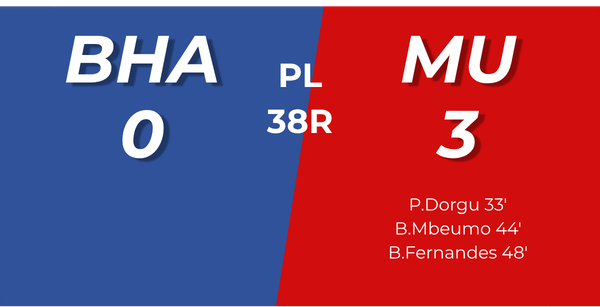
“Carrick’s first match as permanent manager, Dorgu’s return from injury, Amad and Mount rediscovering their best — and Fernandes made history.”
Key Tactical Themes: Right-Side Four-Man Combination, Fluid Double Pivot Build-up vs Midfield Overload, Quick Switch through Short Passing
[ prepared tactics ]
( BRIGHTON & Hove Albion )
Defense
Phase

Build-up
Phase

Attack
phase

press
phase

Defense Phase: 4-4-2 Mid Block
- Brighton’s default is to sustain their pressing phase for as long as possible, transitioning into a 4-4-2 defensive block only when the opposition approaches the final third.
- Given the consistently high intensity of their press, the priority is less about holding a rigid defensive shape and more about the nearest player immediately closing down the ball carrier to win possession back on the spot.
Build-up Phase: 2-1 or 3-1 Shape in Build-up
- Center-backs Lewis Dunk and Jan Paul van Hecke remain in the backline, joined by defensive midfielder James Milner, who also holds his position rather than advancing. When space opens up, van Hecke will drive forward with the ball or play a long ball directly to the striker.
- With Dunk and van Hecke anchoring the back, left-back Ferdi Kadıoğlu, and midfielders Milner and Pascal Groß rotate into the build-up depending on the situation, while the remaining players push forward into attack. Dunk typically sits slightly deeper and more central than van Hecke, with either Kadıoğlu or Milner dropping to fill the space on the left. Whichever of Milner or Groß stays in front of the back two or three acts as the connector between the defensive line and the midfield and attacking units.
- When space appears on the right, van Hecke drives forward himself into an advanced position, effectively transitioning directly into the attack phase.
Attack Phase: Midfield Overload, Quick Switch through Short Passing, Hold-up and Layoff for the Late Runner
- Brighton use their numerical superiority in midfield to retain possession and circulate the ball quickly through short passes toward whichever side of the pitch has less defensive cover — then probe the box through direct runs, cut-backs, or far-post crosses, forcing the opposition into a series of defensive decisions.
- Striker Danny Welbeck operates as a false nine and focal point, dropping deep to receive, while the wide wingers stretch the pitch. Both fullbacks tuck inside of the wingers — widening the gaps in the opposition’s defensive shape and reinforcing Brighton’s midfield superiority in numbers. Left-back Kadıoğlu tends to start in a slightly deeper position than right-back Mats Wieffer, given his additional responsibilities in defensive cover and build-up.
- Rather than switching the ball with a direct long pass when build-up develops on one side, Brighton transfer play to the far winger through a rapid sequence of short passes. Layoffs, third-man combinations, and one-touch exchanges are used liberally throughout, with almost every player involved in the attack moving fluidly — constantly receiving and distributing.
- When the false nine has drawn the defensive line deep enough to expose space in behind, a player such as van Hecke will bypass the midfield entirely with a long ball to connect directly with the front line.
- Inside or around the box, the forward does not typically look to shoot directly. Instead, he holds his ground under pressure or upon receiving, shields the ball, and lays it off for a late-arriving runner to apply the finish.
Press Phase: High Press with Numerical Superiority
- Brighton press aggressively from the front. Because so many players are committed to attacking, there are naturally large numbers still in the opposition’s half when possession turns over — and that presence is immediately weaponized to press from the front line. The attacking structure concentrates bodies in central midfield, and when pressing is triggered, the entire group shifts toward the ball side to force the opposition wide and win the ball back as a collective.
- The space left in behind is an inherent risk, but it is managed carefully: on the right, van Hecke — exceptional both physically and defensively — provides cover, while on the left, either Kadıoğlu or Milner is always held back to protect the space behind the slower Dunk.
( MANCHESTER united )
Defense
Phase

Build-up
Phase

Attack
phase

press
phase

Defense Phase: 4-4-2 Mid Block
- United set up in their familiar 4-4-2 defensive shape, with Bruno Fernandes leading the line alongside the striker and the wide players covering the flanks. The notable departure from their usual approach was a significantly higher defensive line — accepting the risk of space in behind without concern, defending high up the pitch and dropping the entire defensive block back as a unit only when a through ball or long pass was played.
- Aware of Brighton’s tendency to have late-arriving runners finish from outside the box, United’s defenders in and around the penalty area prioritized keeping the ball close and preventing it from breaking loose rather than aggressively jumping out to win it. When second-ball situations did arise outside the box, nearby players were instructed to shield the ball with their back to the opposition first before making a composed defensive decision — rather than immediately attempting to clear.
Build-up Phase: Fluid Double Pivot Build-up, Layoff-Based Progression, Escaping Pressure through Individual Skill
- Rather than building out in a fixed, structured shape, United’s approach kept both center-backs — Martínez and Maguire — anchored in the backline while relying on the fluid movement of Mainoo and Mason Mount to generate the build-up.
- The primary build-up trigger was Mainoo engaging directly in play, with Mount serving a secondary role — positioning himself either in space to receive or as a link to switch the direction of play — creating a flexible, dynamic double-pivot build-up structure.
Attack Phase: Direct Play, Right-Side Overload, Combination Play
- In transition, United looked to play direct long balls toward Mbeumo in the forward right area or Amad along the touchline.
- When the receiving forward found himself isolated or outnumbered — making an immediate counter-attack unviable — United shifted into a possession-based mode, overloading the right side and attacking through that channel.
- The right-side combination unit consisted of four players: Mbeumo — nominally the striker but naturally a right winger — Amad on the right wing, right-back Mazraoui, and Mason Mount. Within this structure, Mbeumo acted as the focal point before cutting inside, Amad held the touchline, Mazraoui underlapped inside Amad to push toward the front line, and Mount filled space flexibly depending on what the situation demanded.
- The team’s overall attacking framework was a 4-3-3 structure, with Mount as a right-sided mezzala and Bruno Fernandes as a left-sided mezzala. In extended possession phases or when United pushed deep into the opposition’s final third, Fernandes would also join the right-side attack. Mainoo rotated positions with Mount when the opportunity arose, joining the attack accordingly.
Press Phase: Reorganize
- To remain consistent with an attacking strategy built around long balls to the right and forward channels, United’s pressing was minimal — the priority was to drop into shape quickly, indirectly slowing the opposition’s attack, and patiently invite them forward to create space rather than pressing aggressively to win the ball back high.
[ Tactics vs tactics ]
brighton Defense
vs UTD attack

brighton build-up
vs UTD press

brighton Attack
vs UTD defense

brighton press
vs UTD build-up

Brighton Defense vs Utd Attack
- Until the opening goal was conceded, Brighton controlled the tempo through intense pressing and quick attacking play, leaving United with few opportunities to penetrate the final third.
- That changed in the 33rd minute. A long ball from United’s half targeted Mbeumo, who won a corner — and from that corner, Fernandes delivered his 21st assist of the season, met by Dorgu’s header to give United the lead. The goal shifted the entire energy of the match: Brighton’s collective intensity dropped noticeably, while United’s lifted in equal measure, and the momentum swung decisively in United’s favor.
- United built their attacks primarily through the four-man right-side unit of Mbeumo, Amad, Mazraoui, and Mount, while Dorgu and Shaw threatened down the left, creating a steady stream of attacking opportunities. In the 44th minute, Amad’s driving run and a sharp 2v1 exchange with Mount inside the box created a decisive opening — and Mbeumo converted the cut-back at the near post to double the lead.
- Around the 42nd minute, Lewis Dunk was visibly struggling, caught on camera in visible distress during a throw-in situation. Hurzeler’s high-tempo, high-press approach had clearly taken a significant physical toll on Brighton’s players — and with that fatigue compounding the drop in morale and concentration triggered by the first goal, the second followed almost inevitably. The strategy had backfired.
- Needing goals to stay in contention, Brighton maintained their high defensive line and aggressive approach in the second half — but in the 48th minute, Dorgu’s pass found Fernandes, who added a third. The scoreline was 3-0.
Brighton Build-up vs Utd Press
- United offered virtually no resistance to Brighton’s build-up. Rather than pressing, they dropped into their defensive shape and withdrew, prioritizing a compact structure to absorb play — and more importantly, to draw Brighton forward and create the space United would need when they won the ball back and transitioned into attack.
Brighton Attack vs Utd Defense
- Before the pivotal 33rd minute, Brighton created several threatening situations. With their build-up progressing cleanly, they were able to execute their attacking plan — and in most cases managed to get the ball into or around the penalty area.
- The primary attacking route ran from Jan Paul van Hecke driving the ball forward on the right, then switching quickly through a series of short passes to Maxin De Cuyper on the far left, where De Cuyper either finished himself or held up play for arriving teammates. Around the 20th minute, De Cuyper’s long-range effort from the left side of the box narrowly missed. There were also moments where, with United’s defensive attention drawn to De Cuyper and the hold-up play, the less-pressured Diego Gómez on the right was presented with finishing opportunities.
- United allowed Brighton to advance into the box, but defended the area effectively. Rather than immediately heading or clearing under pressure, United’s defenders shielded the ball — buying time to assess the situation, preventing additional second-ball and duel scenarios, neutralizing Brighton’s late-runner threat, and enabling cleaner passing decisions under pressure.
- Once the momentum shifted to United, their extended time in the Attack Phase meant fewer defensive situations to deal with. Brighton’s tempo slowed, passing errors crept in, and United found themselves winning the ball back in midfield with increasing regularity.
- At the start of the second half, Brighton replaced De Cuyper with Yankuba Minteh in an attempt to inject more directness and attacking threat from the front — but Mazraoui handled him well and the dynamic remained unchanged.
- As United’s youth players — Shea Lacey, Tyler Fletcher and others — came off the bench, the overall defensive quality dipped slightly, and Brighton’s forwards including Minteh found more room to operate. However, aside from Gómez’s effort that narrowly missed the post in the 58th minute, genuinely threatening moments were scarce.
Brighton Press vs Utd Build-up
- United’s build-up shape had Martínez and Maguire anchoring the backline, Shaw and Mazraoui spread wide on either flank, and Mainoo and Mount moving laterally to support play in the center.
- In the opening stages, Brighton’s numerically superior press worked effectively — United’s forward progression was almost completely suppressed, leaving them to circulate the ball from side to side within their own half or play long balls toward the forwards and flanks. With the ball barely reaching Fernandes, United generated almost nothing in the way of genuine threat.
- After the momentum shifted in United’s favor, the players found a new level of energy and the build-up improved with it. Brighton’s pressing intensity dropped compared to the early stages, allowing United to advance through passing more frequently. Notably, unlike in recent matches, United’s players weren’t relying solely on layoff passes to escape pressure — individual technical ability was also being used to break the press, adding a new dimension to their build-up play.
[ In focus ]
( Bruno Fernandes’ 21st Assist and His Place in the Game )

- With his corner kick assist for Dorgu’s header in the 32nd minute, Bruno Fernandes — the man who carried United through their darkest period — surpassed Thierry Henry (2002/03) and Kevin De Bruyne (2019/20) to become the all-time single-season assist record holder in Premier League history.
- Brighton’s intense early press meant the ball rarely reached Fernandes in the opening stages, limiting his influence on the game’s early exchanges — but the moment that goal went in, United’s attacking play opened up entirely.
- Looking back at a season where United’s matches repeatedly threatened to stagnate, it was Fernandes’ set-piece delivery that so often changed the mood and secured the result. This match was no different — and across the entire campaign, his delivery from dead balls has been quite simply irreplaceable.
- In the 48th minute of the second half, Fernandes received Dorgu’s pass and finished with a first-time shot to make it 3-0 — a reminder, briefly overshadowed by the magnitude of the assist record, that his ability to time runs and score goals is every bit as formidable as his creativity. Whether there is a better attacking midfielder in the world right now is a genuine question. That a player of this caliber has achieved something historic in a Manchester United shirt is something to be celebrated wholeheartedly.
( United’s Breathtaking Second Goal )

- The second goal in the 44th minute was nothing short of artistic. Amad drove forward from the right flank and played it into Mount inside the box — who, in a single touch, combined with Amad in a pass-and-move exchange that stripped Lewis Dunk and James Milner out of the picture before delivering a perfect ball for Mbeumo to finish. It was a moment of genuine beauty.
- Beyond the quality of the goal itself, what made it particularly uplifting was that United’s forwards — who had been struggling for weeks — produced it through a collective piece of attacking play that was both sharp and composed.
- Mbeumo and Amad have shared the burden of criticism over recent matches, alternating in the starting lineup while misfiring in their respective areas — touch and finishing — to the point where their other qualities had faded from view too. The goals they produced against Brighton felt like a genuine turning point — a chance to draw a line under a difficult run and approach next season with renewed confidence. The hope is that both carry this momentum forward and return to — and beyond — their best.
( Reassessing Mason Mount in the Deeper Role )


- Mount’s deployment as a deeper midfielder against Sunderland was widely and fairly criticized — but this match showed a player actively working to address those shortcomings.
- The improvement was most visible in the build-up and attack phases. In the Sunderland game, Mount was passive in build-up and at times positioned himself higher than Fernandes — dragging Bruno deeper and diminishing the team’s overall creativity in the process. Here, he worked tirelessly alongside Mainoo, moving laterally across both sides of the pitch to create numerical advantages in build-up. With Mainoo as the primary build-up trigger, Mount took on the secondary role — positioning himself as the relief option to help the team escape pressure. The division of responsibilities between the two was as clean as it has been.
- In attack, Mount operated primarily on the right, filling the spaces left by the movement of Mbeumo, Amad, and Mazraoui without exception. His runs from deep to front were relentless — and ultimately produced the sublime one-touch pass that created the second goal.
- Defensively, the improvement was equally evident. Against Sunderland, his positional uncertainty and inability to move in sync with the defensive shape gifted opponents far too much space in midfield. Here, he moved as one with the structure, consistently cutting off direct entries into the penalty area. His pressing and tackling still have room to grow, but the sharp reduction in fouls conceded speaks to a markedly improved understanding of the team’s defensive system — enough to make a genuine case for himself as part of next season’s midfield options.
( The Patrick Dorgu Effect )

- The hero of the Arsenal match, in his first start since returning from injury, headed home Fernandes’ record-breaking assist, then created his goal too — active and impactful on both sides of the ball throughout a victory he played a central role in shaping.
- Dorgu is technically unpolished in places, but his energy, aggression, and the physicality that underpins both are what make him such a valuable presence. When deployed as a left winger, Dorgu is naturally right-footed — but his movement in the final third mirrors that of an inverted winger, cutting inside rather than staying wide. This movement creates a natural synergy with Luke Shaw: Shaw’s best work comes either through underlapping runs directly into the box, or through later overlapping runs to deliver crosses when the winger has already cut inside. When Dorgu pushes wide to engage a defender, Shaw can underlap aggressively; when Dorgu cuts inside, Shaw holds wide and joins the attack on the next beat.
- In defensive and pressing situations, Dorgu’s work rate and physicality are equally significant. When United are set in their defensive shape, his ability to engage opponents physically is a real deterrent; in pressing phases, his energy in the front line contributes meaningfully to winning the ball back. In this match, Dorgu showed the confidence to press and attack across to the right side of the pitch — Brighton struggled to cope with it, and United’s third goal was the direct result.
[ tactical adjustments ]
( Leny Yoro as a Right-Back Option )


- In the 74th minute, Yoro came on for Mazraoui and spent roughly 20 minutes in the unfamiliar right-back position. With several other youth players also introduced, the overall defensive structure became somewhat looser — but United held firm and kept a clean sheet. Yoro handled Minteh well, and while there weren’t many defining moments, he showed enough in both defensive situations and one brief underlapping run into an advanced attacking position to suggest the experiment was not without merit.
- Yoro has been relegated to bench duties following an underwhelming performance against Leeds, with criticism centered on uncertain positioning, poor press timing, and insufficient physicality. Since a horror show against Crystal Palace in Matchday 13, he has struggled consistently — and in the process, even the qualities that once defined him, his composure in build-up and range of passing, have quietly disappeared alongside his defensive reliability.
- Having been out of the starting lineup for several matches, he appears to have used the time to reset. Whether Carrick has been deliberately training him at right-back is unknown — but the positional switch makes a considerable amount of sense when weighing his attributes against the squad’s current needs.
- Setting aside current form, his defensive fundamentals are those of a center-back — and that baseline is a reasonable one. Yoro’s natural instinct is to step out and engage rather than hold his shape and retreat, and at full-back, his physical profile becomes an advantage rather than a liability — suggesting many of the defensive risks associated with him at center-back would be reduced in that role. Going forward, his composure in build-up and — crucially — his ability to play long balls offer something United’s current right-back options simply don’t provide.
- Even accounting for injury considerations, the current center-back pecking order has Martínez and De Ligt as the first-choice pairing, Maguire as a reliable backup with significant minutes, and Heavén ahead of Yoro for the fifth spot. In that context, a positional shift to right-back represents a genuine upgrade in terms of both Yoro’s personal development and the squad’s overall depth and versatility.
Leave a Reply